
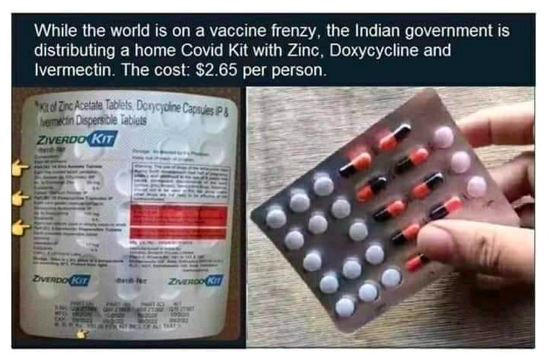
The amazing recovery of the gigantic country of India, in health and economy, is not raved about in western media. In the land of 1.4 billion, 17.7 % of the earth’s population, COVID, is no longer a torment, with people, worrying about it day and night. This summer, when a miracle drug arrived, the people and its leaders were willing and eager to take it. IVERMETIN, was already familiar as an antidote to various parasites and it didn’t take much persuading for authorities to make it quickly and cheaply available. In mid August, the huge state of Uttar Pradesh, distributed packages of Ivermetin, zinc and doxycycline, both for treating people and as a prophylactic. When it proved effective in overcoming the disease and avoiding it entirely, the drug was adopted in more states, resulting in a country with diminishing cases and a return to everyday life.
What prepared this country to accept a repurposed drug, the likes of Ivermetin? What else may be at play in India’s resistance to the coronavirus? As a base, Indian people hold deep confidence in their traditional health practices, and, they have not been wholly overtaken by pharmaceutical beliefs. They have great respect for the immune system. Some speculate that the prevalence of low hygiene, lack of clean drinking water, unsanitary conditions, and crowding, may actually make for a more resilient immune system. A contrary thought for sanitizing busy Westerners.
Their rule of thumb with flus and colds is to do home treatments for a good week before you head to the doctor. This saves money but it is also proactive and empowering. At “first signs of” Indian people gargle with salt water, they steam with turmeric, they drink tea with ginger and lemon and black pepper, and use numerous medicinals known regionally. This strategy, when showing symptoms of possible COVID-19 is hopeful, not hopeless, like the singular “Stay at Home and Do Nothing” order enforced in the West. In fact they are laughing at us – the absurdity of no cures!
State governments and medical powers were also not willing to risk everything for vaccines, given the wait, the expense, the sheer massiveness of campaign, and the hesitancy with foreigners’ vaccines. They took a practical and proactive approach to the illness made approvals of a common, generic, safe, and well-loved drug, Ivermetin, that had already saved them from the ravages of roundworm, whipworm, hookworm, and more – It was a no brainer.
Their practical and proactive approach made Ivermetin was a common, generic safe and well-loved drug, that had already saved them from the ravages of roundworm, whipworm, hookworm and more.Th

Recent Comments